
At some point, almost every business owner runs into a document that needs to be notarized — and usually at the worst possible moment. The loan is ready to close. The partnership agreement needs signatures by Friday. The bank won't open the business account without a notarized corporate resolution. If you've never dealt with this before, it can feel like hitting an unexpected wall when you thought you were almost done.
This guide covers what notarization actually means, which business documents typically require it in North Carolina, and how Remote Online Notarization (RON) has changed the process for business owners who can't afford to spend half a workday tracking down a notary.
What a Notary Public Actually Does
A notary public is a state-commissioned official authorized to verify the identity of people signing legal documents and to witness those signatures. The notary checks your government-issued ID, confirms you're signing voluntarily, watches you sign, and then applies their seal and signature to the document. That seal creates an official record that the signing happened under verified conditions.
What a notary does not do: provide legal advice, review whether the document is legally sound, or explain what you're agreeing to. If you have questions about the substance of a contract or legal filing, that's a conversation for an attorney. The notary's job is to authenticate the act of signing — not to evaluate what's being signed.
This distinction matters because business owners sometimes arrive at a notarization expecting a review of their documents. The notary can't flag a bad clause in your operating agreement or tell you whether the loan terms are fair. That said, working with a notary who also handles legal document preparation — like MBP Services Corp. does — means you have access to both in one place.
Which Business Documents Require Notarization
Not every business document needs a notary. But several document types commonly do — either because state law requires it or because the receiving party (a bank, court, or lender) requires it as a condition of acceptance.
- Commercial real estate transactions: Deeds, deeds of trust, and certain lease agreements involving real property typically require notarization before they can be recorded with the county register of deeds.
- Business loan closings: Lenders require notarized signatures on promissory notes, deeds of trust, and closing packages. This is where loan signing agents come in — they're trained specifically to walk borrowers through these packages and catch errors before they cause a funding delay.
- Power of attorney: If you're granting someone authority to act on your business's behalf — signing contracts, managing finances, handling real estate — that document must be notarized in North Carolina to be legally effective.
- Affidavits: Any sworn written statement being submitted to a court or government agency requires notarization. These come up in business disputes, licensing applications, and certain tax filings.
- Corporate resolutions and banking documents: Many financial institutions require notarized resolutions when opening business accounts, adding authorized signers, or approving major transactions.
- SBA loan and government program documents: Federal and state business assistance programs frequently require notarized certifications and ownership disclosures as part of the application or closing process.
The safest approach: before you finalize any major business transaction or filing, check what the receiving party requires. Finding out your document was rejected because it wasn't notarized — after the fact — is a frustrating and avoidable delay.
Remote Online Notarization: What It Means for Your Business in 2026
North Carolina permanently authorized Remote Online Notarization (RON) under the Electronic Notary Act. As of 2026, updated administrative rules raised the bar for approved platforms and identity verification procedures, making RON more standardized and widely accepted than it was even two years ago. The vast majority of U.S. states now have permanent RON authorization on the books.
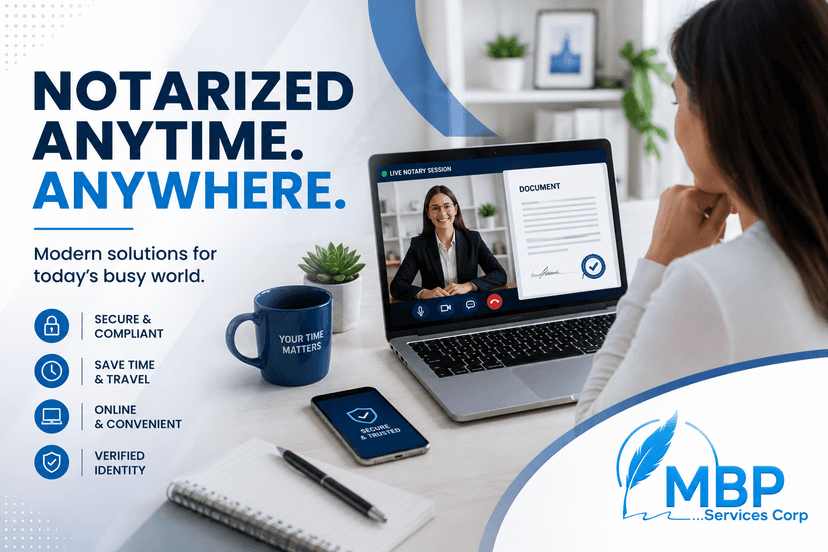
What this means practically: if you're a business owner in North Carolina, you can get documents notarized from your office, your home, or anywhere with a reliable internet connection. The process uses a state-approved video platform. You present your government-issued ID on camera, the notary verifies your identity through the live session and knowledge-based authentication, you sign electronically, and the notary applies a digital seal. The session is recorded and stored. The resulting document carries the same legal weight as one notarized in person.
For business owners, this is genuinely useful. If you're trying to close a commercial loan, finalize a partnership agreement, or get a power of attorney executed, you don't have to block out time to drive somewhere, wait, and drive back. MBP Services Corp. offers RON through virtualnotary365.com — clients across North Carolina can access a commissioned notary by video call without leaving their business. For owners managing operations, staff, and customers, that's not a small thing.
How to Prepare So Nothing Gets Delayed
Most notarization problems are caused by showing up without a valid ID, not having all required signers present, or having already signed a document before the notary can witness it. Any of those will stop the process cold.
Before your appointment — whether in person or via RON session:
- Bring current, government-issued photo ID. Driver's license, state ID, or passport. The name on your ID must match the name on the document. Expired ID is not acceptable.
- Do not sign the document ahead of time. This is the most common mistake. If you've already signed, the notary cannot witness your signature — the document may need to be redone.
- Have every required signer present. If your document requires two members of an LLC to sign, both need to be there — or both on the video call for a RON session. A partial signing creates an incomplete document.
- Review the document before the appointment. Not to sign it — to make sure names, dates, and key details are correct. Notaries cannot make corrections to document content. If something is wrong, you'll need a corrected version first.
- For RON sessions: test your camera and microphone in advance, use a desktop or laptop if possible, and make sure your internet connection is stable. A dropped call mid-session means starting over.
When You Need Document Prep Alongside Notarization
Some business owners arrive at a notarization with documents that aren't ready — forms that are incomplete, templates that haven't been properly filled out, or agreements drafted without the required legal language. A notary can't fix those issues on the spot, but it doesn't have to be a separate trip to a separate office.
MBP Services Corp. offers legal document preparation alongside notary services. That means if you need help getting a document properly drafted before it's executed, that's part of what's available. The same applies if you're working through other business administrative tasks — bookkeeping, tax preparation, or getting financial records in order for a loan application. Having that support available in one place tends to compress the timeline considerably for business owners managing all of this alongside running their actual business.
Schedule Your Appointment
MBP Services Corp. is a North Carolina-commissioned notary public offering virtual notary appointments, Remote Online Notarization, and loan signing services through virtualnotary365.com. If you have a document that needs notarization and you'd rather handle it from your desk than rearrange your day, RON is available for documents where it's permitted.
For loan closings, business agreements, powers of attorney, affidavits, or any other document where you need a notary who knows the process — reach out to schedule. Visit virtualnotary365.com to book an appointment or learn more about available services.